Memory your agents call as a tool
Mnemo indexes every Claude Code, Codex, OpenCode and Pi session on your machines. Any agent can look up what another already worked out, on this laptop or a box three hops away, and read only as much as it needs.
curl -fsSL https://szupzj18.github.io/mnemo/install.sh | shyou ▸ sglang OOMs on the GPU box again. What did we change last time? claude ▸ search_sessions("sglang oom") 3 hits · codex · devbox-a/gpu-box · Sep 22 claude · local · Sep 18 claude ▸ get_context(hit 1, host="devbox-a/gpu-box") --mem-fraction-static 0.88 → 0.80 "OOM gone at batch 64; throughput −3%" claude ▸ Codex lowered --mem-fraction-static to 0.80 on gpu-box on Sep 22 (reached through devbox-a). Your launch script still says 0.88. Want me to apply the same change?
Native to agents
search → context → session over MCP, a Claude Code skill, a Pi extension or a JSON CLI. One command connects every agent it finds.
Found in milliseconds
A ranked SQLite FTS5 index instead of scanning gigabytes of raw logs. Context around a hit in 12 ms, even in a 27k-message session.
Across any topology
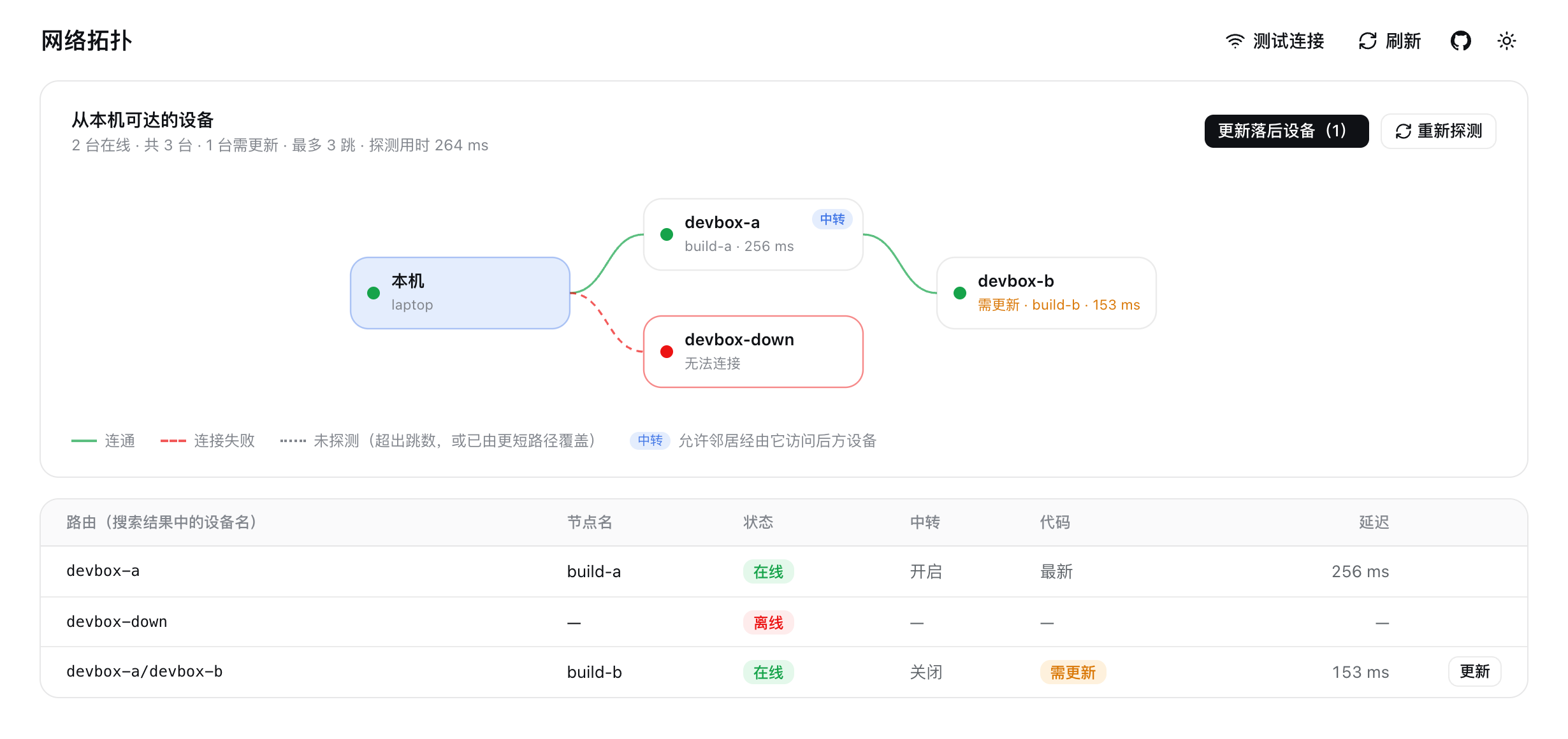
Laptop, devboxes, the box behind the bastion: each device indexes its own sessions; searches pass along relays and merge by rank.
Two agents, two machines, one search.
An agent asks what another agent already did, on another device. The answer comes back ranked, with the agent, device and date attached.
Less digging, same answers.
Grep hands an agent gigabytes of unranked JSON to narrow down. Mnemo hands it the few messages that matter, ranked, with the agent, device and time attached.
One common English term over 729 real session files (3.6 GB of logs), measured 2026-09-24.
- <100 ms
- search, CLI end to end
- 12 ms
- context in a 27k-message session
- 0.1 s
- incremental sync when idle
- ~3,800
- tokens for a top-20 result
Built to be called by agents, not read by people.
Snippets first, full text on demand: the agent stops reading as soon as it has the answer.
- 1
search_sessionsWhere is it?Ranked hits: agent, device route, directory, time and a marked snippet.
- 2
get_contextWhat happened?The messages around a hit, read on the device that holds it.
- 3
get_sessionWalk me through itThe whole session, or just its head or tail.
- 4
list_recent_sessionsWhat was I doing?Recent sessions titled by their first real prompt, no keyword needed.
mnemo setupRegisters the MCP server for Claude Code, Codex and OpenCode, links the Claude Code skill and the Pi extension. Anything already configured is left alone. The tool schemas cost about 500 tokens per session.
mnemo search "sglang oom" --jsonThe same search from scripts and any other tool, as JSON.
Every machine your agents touch, even the ones you can’t reach.
Each device indexes only its own sessions. A search is a message that travels the links you already have, through relays to boxes behind them, and comes back as one ranked list.
- Direct links and relays
- Each device lists only its neighbors. Turn on forwarding on a device and searches pass through it to the devices behind it.
- Routes you can follow
- Every hit carries its route, like devbox-a/devbox-b. Pass it back and reads travel the same path.
- Loop-free, deduplicated
- Stable node ids and a hop budget stop cycles; a device reached twice is reported once, via the shortest route.
- Nothing central
- No server, no shared store. Queries and the messages you ask for travel; indexes and raw logs stay on their device.
- Kept in step
- Upgrade one machine and it brings every reachable device to the same code, relays included.
mnemo remote add devbox-a
ssh devbox-a mnemo node --forward onA window for you, too.
mnemo dashboard opens a local UI: the same search across devices, full sessions on a timeline, and a map of every device a search can reach.

One command.
Installs mnemo, builds the index and connects every agent it finds. Run it again to upgrade this machine and every device behind it.
curl -fsSL https://szupzj18.github.io/mnemo/install.sh | sh- Checks Python 3.7+ and SQLite FTS5, clones to
~/mnemo, linksmnemointo~/.local/bin. - Runs
mnemo setup: registers the MCP server for Claude Code, Codex and OpenCode, links the skill and the Pi extension. - On re-run: pulls, then
mnemo upgradebacks up and rebuilds the index and updates devices running older code.
uv tool install mnemo-search && mnemo setupclaude mcp add --scope user mnemo -- mnemo mcpln -s ~/mnemo/integrations/skills/mnemo ~/.claude/skills/mnemo